



TRConnect
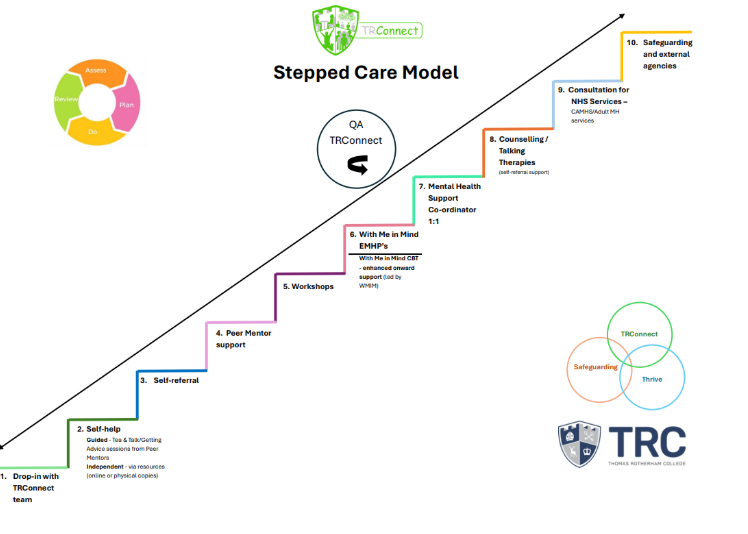
At TRC, we place student mental health and wellbeing at the heart of college life. Our universal offer, inspired by the NHS Five Steps to Wellbeing, promotes everyday positive habits such as connecting with others, being active, learning new skills, giving to others, and practising mindfulness. Alongside this, we provide a stepped approach to support, from inclusive, preventative activities for all, to targeted help for emerging needs, and specialist interventions for more complex challenges. Whether through wellbeing events, mentoring, counselling, or partnerships with NHS Mental Health Support Teams, our aim is to ensure every student has timely access to the right support to thrive both personally and academically.
Stepped Care Model
TRConnect Team

Self-Help Support at College
Self-help support is accessible to all students at TRC. Please see below for further information.
Access Self-Help Materials
- Students can scan the QR codes on posters around college to find helpful resources or access physical copies and QR codes within the Wellbeing Room (M102F). We also offer an array of signposting and resources in our half-termly newsletters.
Wellbeing & Self-Regulation Room (M102F)
- Students can visit this space at any time to self-regulate if feeling upset/overwhelmed during lessons (for a short period of time) and in unstructured time.
- Only one person allowed at a time.
- The room will not be always manned; a member of staff/peer mentor will be able available at drop in and lunch times only.
- The wellbeing room is only meant to be used for a short period of time for students to self-regulate but cannot be used as an alternative to attending lessons.
Events
A range of themed wellbeing events take place throughout the academic year to encourage students to access support, raise awareness of available services, and speak to someone about any worries or concerns they may have.
Drop in sessions
Location: M102F (narrow corridor near Careers Team and Student Services)
During these sessions, students can:
- Access signposting from a member of the TRConnect Team
- Collect practical self-help resources to build strategies for supporting wellbeing.
| Day | Time |
| Monday & Tuesday | 8-9
11.40—12.20 |
| Wednesday & Thursday | 8-9
|
| Friday | 8-8.30 |
Workshops
We offer a range of workshops to help students build practical skills and strategies that support their mental health and wellbeing. These sessions run termly throughout the academic year. All in-house workshops are developed using the NHS Five Ways to Wellbeing, principles of social and emotional literacy, and approaches suitable for students with SEN and SEMH needs. We also work closely with the Thrive team (Learning Support) to ensure every workshop is accessible, inclusive, and supportive for all.
- Understanding Mental Health – Psychoeducation
- Wellbeing and Self-Care
- Relationships and Boundaries
- Time Management, Organisation & Overcoming Procrastination
- Healthy Routines
- Self-Esteem, Confidence & Motivation
- Escape the TRAP – Teenage Relationship Abuse Programme
- Sleep (Led by With in Mind Educational Mental Health Practitioners)
- Exam Stress (Led by With in Mind Educational Mental Health Practitioners)
- Understanding Anxiety and Worry (Led by With in Mind Educational Mental Health Practitioners)
Peer Mentor Support
Our Peer Mentors are trained by the With Me in Mind team to provide mentoring and wellbeing support to other students in college.
What Peer Mentors Do:
- Help the TRConnect team by raising awareness around college of the variety of support on offer to their peers.
- Assist with college events such as Mental Health Awareness Week, World Mental Health Day, Fresher’s Fair and Open Evenings.
- Support peers with low-level worries and managing everyday stresses.
- Offer advice around self-help and external wellbeing resources
How It Works:
- Once a student self-refers to TRConnect and we feel that Peer Mentor support is appropriate, we carefully match a mentor and mentee.
- Sessions can be 1:1 or 2:1, based on student/mentor preference.
- All mentoring takes place in a safe, secure, and supportive environment.
Thomas Rotherham College is committed to providing a safe, secure and supportive environment for all peer mentors and mentees to support their wellbeing, built from effective relationships.
Mental Health Support Team Coordinator 1:1 Support
Our Mental Health Support Team Coordinator can provide wellbeing support for students who:
- Need short-term support following a stressful or traumatic event and do not require long-term or specialist mental health intervention.
- Need someone to talk to in the moment. As a qualified Youth Mental Health First Aider, the Coordinator can support students who may be experiencing a crisis or are having a particularly difficult, stressful, or overwhelming day.
- Require interim support while waiting for other support services or interventions, either within the college or from external agencies, to begin.
- Would benefit from a trauma-informed approach. As a Registered Trauma-Informed Practitioner, the Coordinator understands the impact that trauma and adverse life experiences can have on a young person’s wellbeing, behaviour, relationships, and ability to learn. Support is delivered in a safe, compassionate, and non-judgemental way, helping students build resilience, develop coping strategies, and feel empowered as they work towards their personal goals.
- Need support to access reasonable adjustments within college. The coordinator can work collaboratively with relevant curriculum and support staff to help identify barriers to learning and develop a package of reasonable adjustments that supports the student’s wellbeing, engagement, and ability to successfully manage college life. This may include facilitating communication between departments, advocating for individual needs, and ensuring appropriate support is in place wherever possible.
With Me in Mind and Talking Therapies – Referral Support
The TRConnect team can:
- Support and send referrals to With Me in Mind (for under 19s)
- Signpost and advise on self-referrals to Talking Therapies (for over 16s)
Once a student self-refers and we feel one of the above routes are appropriate, we will discuss this further and agree next steps.
With Me in Mind Education Mental Health Practitioners – NHS Mental Health Service
With Me in Mind works with Thomas Rotherham College to provide evidence-based preventative early intervention for students with mild to moderate mental health needs.
What They Offer:
- Evidence-based interventions for mild to moderate mental health needs
- 1:1 sessions with an Educational Mental Health Practitioner (50 minutes, 6–8 weeks, scheduled around college timetables)
- Workshops throughout the year on various wellbeing themes
- Supporting the senior mental health lead in college to introduce or develop a whole college approach.
- Support for college staff and liaison with external services
- Help for students with more severe needs to access specialist NHS services via consultations.
With Me in Mind are a low level, recent/emerging mental health support service so will not accept referrals for students who are struggling with:
- Trauma
- Bereavement
- Drug & alcohol use
- Self-harm or suicidal thoughts/attempts
- Risky behaviour towards others
- Attending college regularly
Areas that can be supported:
- Low mood
- Worry & anxiety
- Simple phobias
- Sleep problems
- Panic attacks
- Behavioural & emotional difficulties
The above must be recent/emerging difficulties (anything up to 2 years)
With Me in Mind E-Clinic
- Students (11–19): Download the free eClinic apple or eClinic android to book an online chat with a practitioner.
- Parents & Carers: Use Parents Plus apple or Parents Plus android to book an online chat.
Talking Therapies – NHS Support
Talking therapies (psychological therapies) can be used to treat many different mental health problems. They involve talking to a trained professional about your thoughts, feelings and behaviours.
What Talking Therapies Can Help With:
- Difficult feelings such as low mood, worries, and stress
- Depression, including postnatal depression
- Anxiety, including social anxiety, phobias, and OCD
- Post-Traumatic Stress Disorder (PTSD)
- Eating disorders (anorexia, bulimia)
- Bipolar disorder
- Personality disorders
- Coping with long-term health conditions (e.g., IBS, chronic pain)
You do not need a formal diagnosis to access talking therapies.
How to Access Talking Therapies
- For some mental health problems (such as anxiety and depression), you can self-refer without speaking to a GP.
- You must be registered with a GP and aged 16 or older.
Rotherham, Doncaster and South Humber
https://www.rdash.nhs.uk/services/nhs-talking-therapies/
Sheffield
https://www.sheffieldtalkingtherapies.nhs.uk/
Counselling Support
Once we receive a self-referral and deem counselling appropriate:
- Students will be assigned a counsellor who will contact you to arrange an initial assessment.
- Together, the student and counsellor will agree on next steps, which may include up to 6 counselling sessions.
- After the agreed number of sessions, a review will take place to decide whether sessions should be extended or if students will be discharged.
- At the point of discharge, the counsellor will discuss any additional college support that may be helpful, or any external services that they can signpost you to.
What Counselling Offers:
- A confidential space to explore thoughts and feelings
- Support to work towards a better quality of life
Counselling Can Help With:
- Common mental health and psychological problems
- Anxiety
- Depression
- Abuse
- Trauma
- Self-harm
- PTSD (depending on presentation)
- Phobias
- Obsessive-Compulsive Disorder (OCD)
Counsellors cannot support
- Those who are engaging with other psychological therapy
- Eating disorders
- Addiction
- Active suicide attempts
- Those who meet the threshold for CAMHS/AMHS intervention but refusing to engage.
Safeguarding and external services
- Severe and complex mental health problems.
- Schizophrenia
- Substance misuse
- Active suicidal attempts
- Specialised eating disorder support
- Psychosis
- Addiction
- Open to CAMHS accessing psychological intervention
- Choosing not to engage with CAMHS psychological interventions
- On any medication for the above
When a student is in crisis or needs a higher level of support or is above our thresholds. We have links with:
- CAMHS
- Adult mental health services
- Social care – to support students and family.
- Police
- MASH
- MESMACS
- ROADS
- Hopian
For further information about our safeguarding team, please click HERE
TRConnect Newsletters
The TRConnect team sends newsletters every month to students, staff, and parents/carers.
Each issue is themed around common mental health and wellbeing topics and includes:
- Self-help resources
- Information about different services and support within college
- Information about enrichment opportunities in college
- Events in college
- Feedback following Student Wellbeing Survey’s
- Articles and tips, with collaboration from college staff and the Peer Mentor team
Newsletter – Issue 1 – September 2025
Newsletter – Issue 2 – Anxiety & Stress
Newsletter – Issue 3 – Sleep January 2026 -update
Newsletter – Issue 4 – Low Mood – February 2026
Issue 5 – Exam Stress – April 2026
Newsletter – Issue 6 – Mindfulness & Grounding May 2026
Issue 7 – Self-care over summer – July 2026
NHS 5 ways of wellbeing
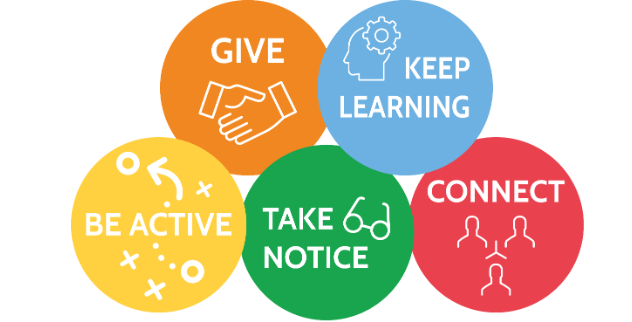
Five Steps to Mental Wellbeing
Connect with Other People
NHS Advice
Good relationships are important for your mental wellbeing. They can:
- Help you build a sense of belonging and self-worth
- Give you an opportunity to share positive experiences
- Provide emotional support and allow you to support others
What TRC Offers
- Dedicated social time: Every day from 11:40 – 12:20, students can take dinner and spend time with friends.
- Flexible schedules: Different day lengths most days, giving you more chances to connect with family or friends or visit someone who needs support.
- Inclusive classroom activities: Ice-breaker activities whenever you change seats to help you meet new people.
- Community partnerships: Links with Voluntary Action Rotherham and a work placement team to help you find voluntary work; opportunities shared via social media and weekly FUTURES email.
- Digital connectivity: Microsoft 365 subscription for every student, ensuring you can stay connected with staff and peers during remote learning.
- Extra-curricular and events: A wide range of activities and themed weeks (e.g. World Culture Day, World Mental Health Week, Holocaust Memorial Week, Parliament Week, Leavers’ Celebration, Festive Karaoke) plus student groups to meet others with similar interests.
Be physically active
NHS Advice
Being active is not only great for your physical health and fitness. Evidence also shows it can improve your mental wellbeing by:
- Raising your self-esteem
- Helping you set goals or challenges and achieve them
- Causing chemical changes in your brain which can positively change your mood
What TRC Offers
To support you and improve your mental wellbeing through physical activity, TRC:
- Affordable gym membership:
- £20 for access during the college day only, term time.
- £50 for full access (college day, evenings, weekends, and college holidays)
- Bursary students can enquire about options at the gym reception desk
- Courses involving physical activity: e.g., Outdoor Pursuits
- Sports Academies: A full range offered in partnership with external organisations
- Extra-curricular activities: Various physical opportunities beyond lessons
- Movement breaks: 10-minute breaks between lessons (and mid-way through double lessons)
Keep learning new skills
NHS Advice
Research shows that learning new skills can improve your mental wellbeing by:
- Boosting self-confidence and raising self-esteem
- Helping you build a sense of purpose
- Helping you connect with others
Even if you feel like you do not have enough time, or you may not need to learn new things, there are lots of different ways to bring learning into your life.
What TRC Offers
To support you in learning new skills, TRC:
- Partner with LIS: Every student can develop interdisciplinary thinking through our link with the London Interdisciplinary School.
- Workplace experience: Specific calendared days and a named work placement officer for every student to help you take on workplace responsibilities.
- Leadership opportunities: Roles such as peer mentoring and student council.
- Skill-building activities: Extra-curricular options like public speaking and coaching in Kairos, beginners German, or a certificate in British Sign Language.
- Hobby-based learning: A wide range of extra-curricular opportunities to try new hobbies that challenge you.
Give to others
NHS Advice
Research suggests that acts of giving and kindness can help improve your mental wellbeing by:
- Creating positive feelings and a sense of reward
- Giving you a feeling of purpose and self-worth
- Helping you connect with other people
It could be small acts of kindness towards others or larger ones like volunteering in your local community.
Examples you could try:
- Saying thank you to someone for something they’ve done for you
- Asking friends, family, or colleagues how they are—and really listening to their answer
- Spending time with friends or relatives who need support or company
- Offering to help someone with DIY or a work project
- Volunteering in your community (e.g., at a school, hospital, or care home)
What TRC Offers
To enable you to improve your mental wellbeing through acts of giving and kindness, TRC:
- Opportunities to say thank you: Events like International Women’s and Men’s Day, World Kindness Day, Thank a teacher, and Candy Cane exchange.
- Charity fundraising: For causes such as Foodbank, Mission Christmas (Cash for kids), Wear It Pink, Save the Children, and Royal British Legion.
- MIND Time to Talk Day: Coffee and cake sessions to encourage meaningful conversations with peers.
- Flexible schedules: Different day lengths most days, giving you time to visit friends or family who need support or company.
- Community volunteering: Partnerships with Voluntary Action Rotherham and a work placement team to help you find voluntary work; opportunities shared via social media and weekly FUTURES email.
Pay attention to the present moment (mindfulness)
Paying more attention to the present moment can improve your mental wellbeing. This includes your thoughts and feelings, your body, and the world around you.
Some people call this awareness “mindfulness.” Mindfulness can help you:
- Enjoy life more
- Understand yourself better
- Positively change the way you feel about life and how you approach challenges
What TRC Offers
To enable you to use mindfulness, TRC:
- Weekly mindfulness and meditation sessions
- Resources from TRConnect (Health and Wellbeing team) to help you learn about mindfulness independently.